

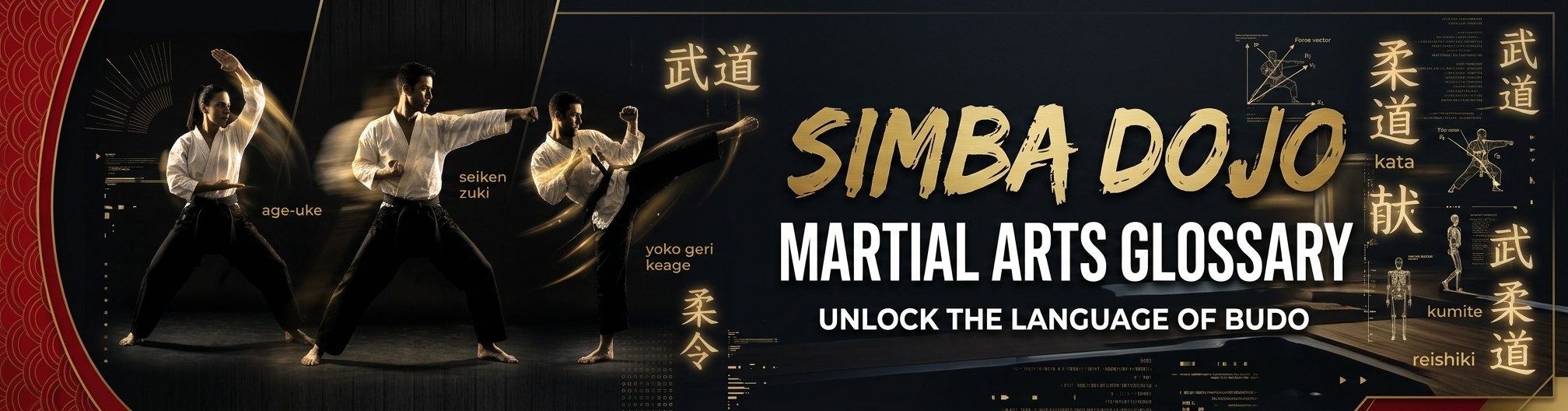
Martial Arts Glossary
Glossary of commonly used terms in the Japanese martial arts.
Glossaries
| Term | Definition |
|---|---|
| Kihon-Rensshū | Kihon-renshu (基本練習)Kihon-renshu (基本練習) refers to the methodical practice and repetition of fundamental techniques in traditional Karate—particularly emphasized within Shotokan—where practitioners systematically isolate, refine, and drill basic blocks, strikes, punches, kicks, and stances. Serving as the primary foundational pillar of all Karate training, kihon-renshu develops muscle memory, proper kinetic alignment, power generation, and mental focus before techniques are applied in complex forms (kata) or dynamic sparring (kumite).
Author - Sensei Miller
Hits - 11 Synonyms -
basics practice, fundamental technical training, basic karate repetition, foundation drilling, fundamental karate practice |
| Kihon-Waza | Kihon-waza (基本技)Kihon-waza (基本技) refers to the core repertoire of fundamental techniques—including stances, blocks, punches, strikes, kicks, and sweeps—that constitute the foundational mechanical catalog of traditional Karate, most notably emphasized in Shotokan. While kihon-renshu refers to the act or process of drilling these basics, kihon-waza represents the individual techniques themselves and the underlying structural mechanics that govern their execution. They serve as the essential building blocks from which all complex patterns (kata) and practical combat applications (kumite) are constructed.
Author - Sensei Miller
Hits - 42 Synonyms -
fundamental techniques, basic karate moves, foundational skills, core karate techniques, basic technical catalog |
| Kime | Kime (決め / 決定)Kime is the total, instantaneous contraction of all relevant muscles at the precise moment of target impact in traditional Japanese martial arts—most notably emphasized in Shotokan Karate—delivering maximum focus, structural integrity, and kinetic energy into a strike, block, or kick. Immediately following this split-second lock and energy transfer, the muscles must instantaneously relax (kime-hanashi) to allow for rapid follow-up movement, fluid defense, or transition to another technique.
Author - Sensei Miller
Hits - 52 Synonyms -
focus, decisive focus, muscle lock, terminal contraction, dynamic focus, impact focus |
| Kōhai | Kōhai (後輩)Kōhai (frequently Romanized as Kohai) is a foundational Japanese social concept and honorific term translating to "junior student," "junior member," or "junior companion." In traditional Budo, Shotokan Karate, and broader Japanese society, it refers to a practitioner who has less experience or has joined the dojo later than their senior counterparts (Senpai). A Kōhai approaches training with humility, enthusiasm, and a readiness to learn from those who have walked the path before them.
Author - Sensei Miller
Hits - 49 Synonyms -
Junior student, junior member, junior practitioner, novice, apprentice, beginner student. |
| Kokutsu-dachi | Kokutsu-dachi (後屈立ち)Kokutsu-dachi, commonly referred to as the "back stance," is a fundamental, defensive stance in traditional Japanese Karate—most prominently featured in Shotokan—characterized by a heavy weight distribution shifted toward the rear leg (typically 70% rear, 30% front). Positioned along a linear alignment with the feet perpendicular to each other, kokutsu-dachi lowers the practitioner's center of gravity, creates natural spatial distance (ma-ai) away from an incoming attack, and prepares the front leg for rapid defensive kicking or explosive forward counter-attacks.
Author - Sensei Miller
Hits - 39 Synonyms -
back stance, rear-weighted stance, crouched back stance, rear-leaning posture |
| Kosa-dachi | Kosa-dachi (交差立ち)Kosa-dachi, commonly referred to as the "crossed-leg stance" or "cross stance," is an advanced, transitional stance in traditional Japanese Karate—frequently featured in Shotokan—characterized by the crossing of the legs where the front foot is planted flatly on the ground while the ball of the rear foot rests just behind or adjacent to the front heel. By significantly narrowing the base of support and lowering the center of gravity, kosa-dachi enables rapid direction changes, dynamic evasive steps, and explosive entry or recovery maneuvers during close-range combat.
Author - Sensei Miller
Hits - 12 Synonyms -
crossed-leg stance, cross stance, intersecting stance, crossed-foot posture |
| Kosoto-Gake | Kosoto-Gake (小外掛)Kosoto-gake, commonly translated as the "minor outer hook," is a fundamental sacrifice or foot-hooking takedown technique widely utilized across Japanese martial arts—most prominently in Judo and incorporated into close-quarters Shotokan Karate self-defense application (bunkai). The technique involves breaking the opponent's balance toward their rear-outer corner (kuzushi), stepping outside their target leg, and wrapping or hooking the calf/heel with one's own leg to sweep or drive them backward over their compromised base.
Author - Sensei Miller
Hits - 39 Synonyms -
minor outer hook, small outer hook, rear foot trap takedown, outer leg trip, minor outer trip |
| Kouchi-Gake | Kouchi-Gake (小内掛)Kouchi-gake, commonly translated as the "minor inner hook," is a fundamental leg-hooking takedown technique utilized across traditional Japanese martial arts—originating in classical Jujutsu and Judo, and integrated into close-quarters Shotokan Karate self-defense application (bunkai). The technique involves unbalancing an opponent toward their rear-inner corner (kuzushi) and using the sole or heel of one's foot to hook inside and behind the opponent's heel or lower calf, driving them backward to collapse their base.
Author - Sensei Miller
Hits - 11 Synonyms -
minor inner hook, small inner hook, inner heel trap takedown, inside foot trip, minor inner trip |
| Ku | Ku (空)Ku is a fundamental philosophical, spatial, and spiritual concept in traditional Japanese martial arts—most notably within Shotokan Karate—translating to "void," "emptiness," "sky," or "space." Derived from Mahayana Buddhist philosophy (Śūnyatā), Ku represents both a physical realm of open distance and infinite movement possibilities, and a psychological state of mind where a practitioner operates free from rigid preconceptions, fear, hesitation, or ego, allowing spontaneous, adaptive reactions in combat.
Author - Sensei Miller
Hits - 49 Synonyms -
void, emptiness, sky, space, open space, formlessness, spiritual void |
| Kumite | Kumite (組手)Kumite is the sparring component of traditional Karate—serving alongside fundamentals (kihon) and forms (kata) as one of the three main pillars of training—wherein two practitioners apply defensive and offensive techniques against each other in real time. Ranging from highly structured, pre-arranged partner drills to fluid, unscripted free sparring, kumite provides the practical platform for testing distance management, timing, reaction speed, spirit, and physical technique under dynamic combat conditions.
Author - Sensei Miller
Hits - 47 Synonyms -
karate sparring, martial arts sparring, controlled combat practice, engagement of hands, karate fighting |
| Kyu | Kyu (級 / 九)Kyu in Japanese martial arts—most notably within Shotokan Karate—holds a dual significance: it refers to the grade or class ranking system (級) assigned to mudansha (colored belt practitioners below black belt level), and it is the alternate pronunciation for the cardinal number nine (九). As a ranking designation, the Kyu system measures a student's progress along a descending scale (from 10th or 9th Kyu down to 1st Kyu) before they qualify for black belt (Dan) examination.
Author - Sensei Miller
Hits - 61 Synonyms -
nine, student rank, colored belt level, student grade, class, ninth digit |
| Mae | Mae (前)Mae is a fundamental directional and spatial term in traditional Japanese martial arts—most notably within Shotokan Karate—translating to "front," "forward," or "in front." It denotes techniques, stances, footwork, and tactical vectors directed straight ahead along the central line of engagement (seika tanden alignment), serving as the foundational directional prefix for iconic strikes, kicks, and evasive movements.
Author - Sensei Miller
Hits - 50 Synonyms -
front, forward, in front, ahead, frontal direction |
| Mae-geri-kakomi | Mae-geri-kekomi (前蹴込 / 前蹴り込)Mae-geri-kekomi (more commonly transcribed as Mae-geri kekomi or Mae-geri kekomi-waza) is the fundamental front thrust kick in traditional Japanese Karate—most notably emphasized in Shotokan—characterized by a high knee chamber followed by an explosive forward extension of the hip and leg that drives the ball of the foot (koshi) or heel (kakato) deep into the opponent's torso. Unlike its snapping counterpart (mae-geri-keage), mae-geri-kekomi delivers heavy penetrating force designed to breach an opponent's guard, push them back, or disable them with a single decisive blow.
Author - Sensei Miller
Hits - 28 Synonyms -
front thrust kick, penetrating front kick, thrust kick, linear front kick, front thrusting kick |
| Mae-tobi-geri | Mae-tobi-geri (前跳び蹴り)Mae-tobi-geri is the jumping or flying front kick in traditional Japanese Karate—most famously showcased within Shotokan—characterized by an explosive vertical or forward leap where the practitioner launches off the ground, chambers both knees in mid-air, and delivers a powerful front kick (mae-geri) with the striking foot before landing in a stable, controlled stance. Combining jumping momentum, spatial elevation, and precise timing, mae-tobi-geri is designed to strike high targets (jodan), overcome long distances, or bypass an opponent's low defensive guard.
Author - Sensei Miller
Hits - 29 Synonyms -
jumping front kick, flying front kick, mid-air front kick, leap front kick, flying kick |
| Makiwara | Makiwara (巻藁)Makiwara is a traditional Okinawan striking post utilized in traditional Karate—including Shotokan—to develop penetration power, proper skeletal alignment, knuckle conditioning, and focus (kime). Consisting of a tapered wooden board anchored firmly into the ground or mounted to a wall, topped with a bound striking pad, the makiwara provides progressive mechanical resistance that instantly exposes flaws in a practitioner's stance, wrist structure, hip rotation, and impact focus.
Author - Sensei Miller
Hits - 46 Synonyms -
striking post, striking board, punch board, target post, Okinawan conditioning post |