The Center on Main™ in Verrado®
4239 N Village Street
Buckeye, AZ 85396

Monday and Friday
7:30 pm - 8:30 pm

The Center on Main™ in Verrado®
4239 N Village St
Buckeye, AZ 85396

Monday and Friday
7:30 pm - 8:30 pm

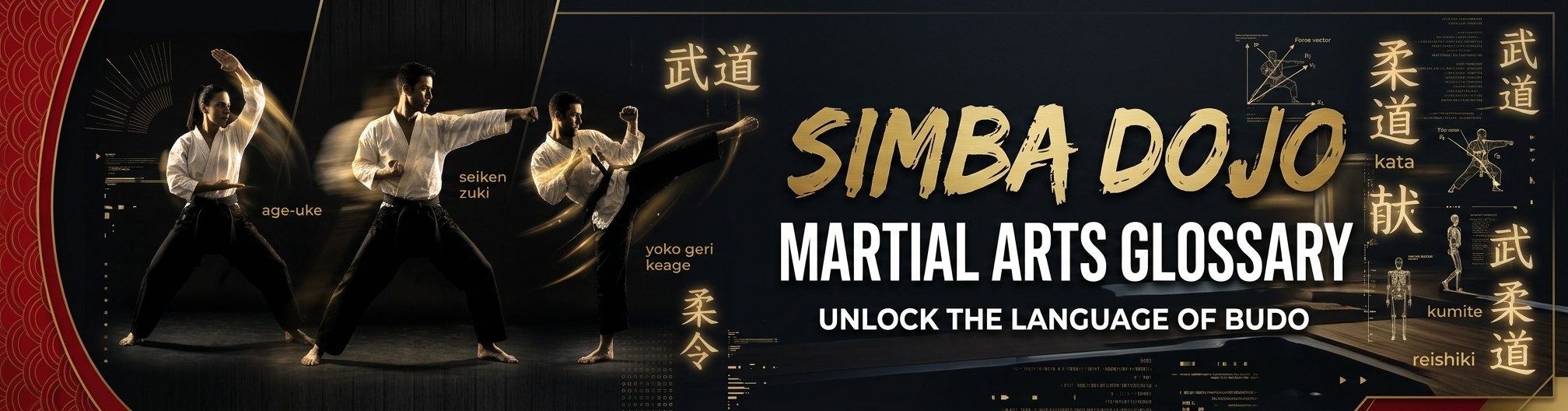
simba dojo glossary banner v2

Karate

Search for glossary terms (regular expression allowed)

Glossaries

Term Definition
Karate

Karate (空手)

Karate (空手) is a traditional striking-based Japanese martial art originating from the Ryukyu Kingdom (modern-day Okinawa) that synthesizes indigenous Okinawan fighting methods (Te) with Chinese martial arts (Kenpo). It systematically employs unweaponed offensive and defensive strikes, including punches (tsuki), strikes (uchi), kicks (geri), blocks (uke), dynamic footwork, and joint manipulations (joint locks/tuite) for physical self-defense, character development, and spiritual refinement.


Etymology & Structural Breakdown

The term consists of two primary Japanese kanji characters:

  • Kara (空): Empty, void, or clear of self-interest/ego. (Historically written as 唐, referring to China / Tang Dynasty).

  • Te (手): Hand or physical technique.

Originally referred to as Tōde or Karate (唐手, "Chinese Hand"), Okinawan masters—most notably Gichin Funakoshi—formally adopted the homophonous kanji 空手 ("Empty Hand") in the 1930s. This shift reflected both a commitment to weaponless defense and the Zen philosophical concept of emptying the mind of ego, malice, and distraction.

Key Characteristics & Components

  • Three Pillars of Training (San-Shin): Structured into Kihon (basics/fundamentals), Kata (pre-arranged formal patterns), and Kumite (sparring/engagement).

  • Kinetic Power Generation (Kime): Focuses maximum energy and muscular contraction at the instant of impact, supported by dynamic hip rotation (koshino-kaiten) and ground reaction forces.

  • Open-Hand & Closed-Hand Strike Diversity: Utilizes multiple anatomical striking surfaces, including the knuckles (seiken), edge of the hand (shuto), palm heel (teisho), elbows (empi), and ball of the foot (koshiki).

  • Breath & Core Integration: Synchronizes deep abdominal breathing (ibuki) with physical movement to anchor stability and energy at the center of gravity (tanden).

Practical and Tactical Application in Shotokan Karate

Shotokan Karate, founded by Gichin Funakoshi and modernized by his son Gigo Funakoshi, emphasizes specific tactical approaches to Karate application:

  • Long-Distance Linearity & Speed: Employs deep, powerful stances (such as Zenkutsu-dachi and Kiba-dachi) to develop long-range explosive entries (sen-no-sen) and sharp evasive footwork.

  • Defensive Deflection into Immediate Counter: Utilizes definitive blocks (gedan-barai, age-uke, soto-uke) executed with hip torque to instantly break an opponent's momentum before launching a decisive reverse punch (gyaku-zuki).

  • Kata Application (Bunkai): Deconstructs movements within forms (such as the Heian, Tekki, and advanced Bassai/Kanku series) into practical close-quarters striking, joint locks, sweeps (ashi-barai), and takedowns.

Key Variations & Mechanics

  • Okinawan vs. Japanese Styles: Okinawan lineages (e.g., Shorin-ryu, Goju-ryu, Uechi-ryu) often feature upright stances, circular paths, and heavy conditioning (hojo undo), whereas Japanese adaptations (e.g., Shotokan, Wado-ryu, Shito-ryu) emphasize expanded distance, linear acceleration, and athletic standardization.

  • Biomechanical Mechanics: Power flows sequentially along a kinetic chain originating from push-off against the floor, transferred through rapid hip snapping (koshino-kaiten), and terminating at the striking point upon contraction (kime).

Budo & Cultural Significance

In Budo culture, Karate is far more than a physical self-defense system; it is a lifelong discipline for personal character cultivation (Karate-do). As summarized in Master Funakoshi's Niju Kun (Twenty Precepts), "Karate begins and ends with respect" (Karate-do wa rei ni hajimari, rei ni owaru). Through rigorous practice, karateka cultivate humility, perseverance (osu/ninshin), emotional composure (zanshin), and ethical integrity, seeking physical strength while honoring peace and non-violence.

See the article in Simba Dojo Blog- The Evolution of Karate: From Okinawan Tradition to Global Discipline

Author - Sensei Miller
Hits - 17
Synonyms: Karate-do, empty hand art, Japanese martial art, Okinawan striking art, martial art of self-defense
Ask a question
1000 characters left