The Center on Main™ in Verrado®
4239 N Village Street
Buckeye, AZ 85396

Monday and Friday
7:30 pm - 8:30 pm

The Center on Main™ in Verrado®
4239 N Village St
Buckeye, AZ 85396

Monday and Friday
7:30 pm - 8:30 pm

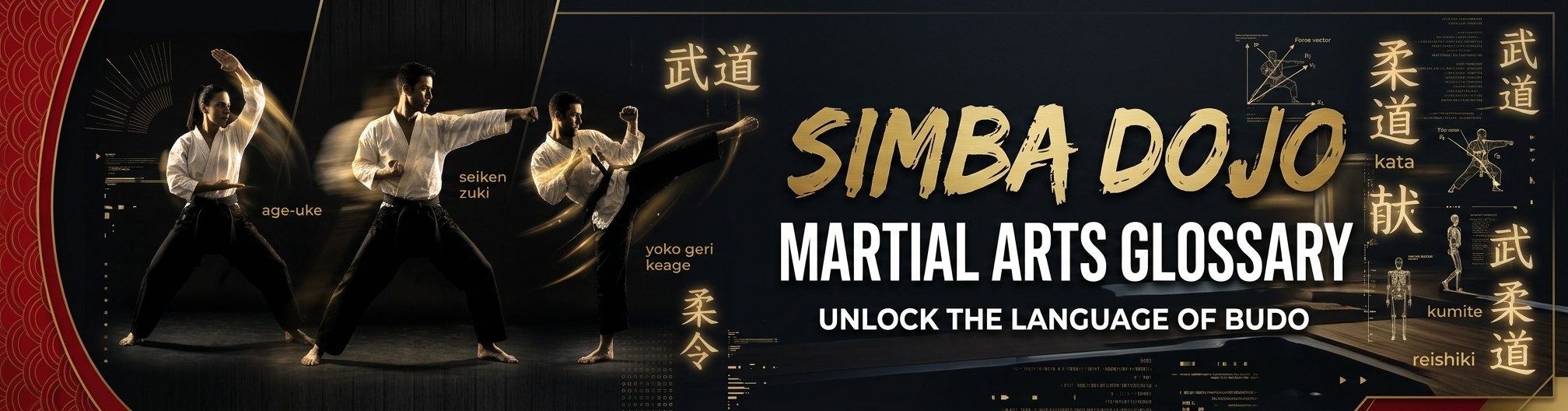
simba dojo glossary banner v2

Waza

Search for glossary terms (regular expression allowed)

Glossaries

Term Definition
Waza

Waza (技)

Waza is a fundamental [[4]] concept translating to "technique," "skill," "artistry," or "method of execution." In Shotokan Karate and modern [[5]], Waza refers to the comprehensive body of physical actions—including strikes, punches, blocks, kicks, stances, evasions, joint locks, and throws—that have been systematically refined through centuries of study to achieve maximum martial efficiency with minimal wasted effort.

Etymology & Structural Breakdown

The term Waza derives from a singular Japanese kanji character rooted in craftsmanship and physical skill:

  • Waza (技): Meaning "technique," "art," "skill," "craft," "ability," or "performance."

In martial arts terminology, Waza (技) appears both as an independent concept representing technical mastery and as a suffix categorizing specific families of techniques (e.g., Tsuki-waza for thrusting techniques, Geri-waza for kicking techniques, or Uke-waza for blocking techniques).

Key Characteristics & Components

  • Biomechanical Efficiency (Rational Movement): True Waza relies on proper body alignment, hip rotation (Koshi no Kaiten), center-of-gravity transfer (Tanden), and kinetic chaining rather than brute muscular force.

  • Kime (Focus) and Timing (Hyōshi): A technique is only recognized as valid Waza when it unifies speed, balance, breath control (Kokyū), and instant muscular locking at the point of impact.

  • Repeatability and Precision: Demands that movement can be performed flawlessly under extreme fatigue, pressure, or unpredictable combative scenarios.

  • Harmonization of Mind, Body, and Spirit (Shin-Gi-Tai): Waza represents the physical manifestation (Gi) bridging internal mental intent (Shin) with physical body mechanics (Tai).

Practical and Tactical Application in Shotokan Karate

In Shotokan Karate, Waza forms the core curriculum through which practitioners progress from raw mechanics to spontaneous self-defense:

  • Foundational Categorization: Grouped systematically into core training domains, including Kihon Waza (basic techniques), Kata Waza (formal pattern applications), and Kumite Waza (sparring tactics).

  • Combination and Fluidity (Renzoku Waza): Linking individual techniques seamlessly—such as following a Age-uke (rising block) immediately with a Gyaku-zuki (reverse punch)—to overwhelm an opponent's defense.

  • Tactical Adaptation (Henka Waza): Modifying a technique in real-time response to an opponent's counter-movement or unexpected change in combative distance (Maai).

Key Variations & Mechanics

  • Kihon Waza (基本技): Fundamental techniques practiced in isolation or straight lines to build structural alignment, power, and muscle memory.

  • Tsuki-waza (突技) & Uchi-waza (打技): Thrusting punch techniques and curved/whipping striking techniques.

  • Geri-waza (蹴技): Kicking techniques utilizing the legs and feet.

  • Uke-waza (受け技): Defensive blocking, parrying, and deflecting techniques.

  • Nage-waza (投げ技) & Kansetsu-waza (関節技): Throwing/takedown techniques and joint-locking techniques embedded in traditional Bunkai.

  • Tokui Waza (得意技): A martial artist's personal favorite or most highly refined specialty technique.

Budo & Cultural Significance

In Budo, Waza is far more than a collection of mechanical tricks for physical combat; it is a vehicle for personal transformation. Through the tireless refinement of Waza (Shugyō), the practitioner polishes their character, cultivates humility, and learns self-discipline. According to the classical tripartite concept of Shin-Gi-Tai (Mind, Technique, Body), technical skill (Gi) acts as the visible mirror of inner spirit (Shin). True mastery of Waza means reaching the state of Mushin (no-mind), where techniques flow naturally without conscious thought or ego.

Author - Sensei Miller
Hits - 33
Synonyms: Technique, skill, martial art technique, physical method, artistry, combative maneuver.
Ask a question
1000 characters left