The Center on Main™ in Verrado®
4239 N Village Street
Buckeye, AZ 85396

Monday and Friday
7:30 pm - 8:30 pm

The Center on Main™ in Verrado®
4239 N Village St
Buckeye, AZ 85396

Monday and Friday
7:30 pm - 8:30 pm

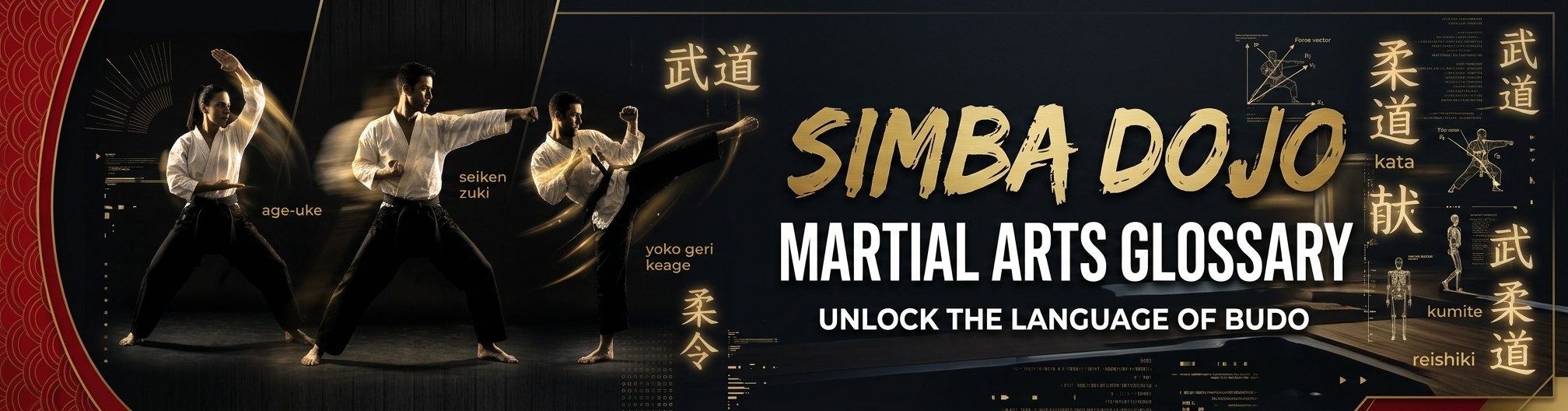
simba dojo glossary banner v2

Go

Search for glossary terms (regular expression allowed)

Glossaries

Term Definition
Go

Go (五)

In Japanese, Go (五) is the cardinal number five ($5$). Within the context of traditional Japanese martial arts and Shotokan Karate, it denotes counting, grouping, technical sequences, numbered sets of kata, and fundamental principles organized into fivefold structures.

Etymology & Structural Breakdown

The kanji 五 originates from ancient Chinese oracle bone script, where it was originally depicted as an "X" shape between two horizontal lines—representing the intersection of heaven and earth (the five elements or directions). Over time, the character evolved into its current five-stroke structure (五). Phonetically, it is pronounced with a short, voiced "o" sound in Japanese, corresponding to the cardinal value of 5.

Key Characteristics & Components

  • Base Cardinality: Represents the quantity five ($5$) in standard Japanese counting (ichi, ni, san, shi, go).

  • Structural Anchor: Functions as a common grouping metric in Japanese culture, philosophy, and classical martial arts curricula.

  • Compound Component: Frequently combines with other kanji to form martial concepts, such as Goju (five principles/hard-soft), Goshitsu (five elements), or Gonan (five difficulties).

Practical and Tactical Application in Shotokan Karate

In Shotokan Karate training, Go is applied practically across multiple dimensions:

  • Counting and Cadence: Used by instructors during Kihon (basics) and Kata (forms) practice to pace five consecutive techniques, combinations, or repetitions (Ichi! Ni! San! Shi! Go!).

  • Five-Step Kumite (Gohon Kumite): A foundational sparring drill consisting of five consecutive linear attacks and defenses, designed to develop proper distance (maai), timing, block accuracy, and counter-striking stability.

  • Five Heian Kata Series: Shotokan integrates five fundamental forms—Heian Shodan, Heian Nidan, Heian Sandan, Heian Yondan, and Heian Godan—to systematically teach beginner-to-intermediate movement mechanics.

Key Variations & Mechanics

  • Sino-Japanese vs. Native Japanese Counting: While Go (五) is the Sino-Japanese cardinal number, the native Japanese word for five is Itsutsu (五つ).

  • Rhythmic Rhythm in Gohon Kumite: Mechanics require maintaining consistent footwork, hip engagement (koshino-kaiten), and strong posture across all five defense/attack transitions without breaking balance or momentum.

Budo & Cultural Significance

The number five holds profound philosophical resonance throughout Japanese history and Budo. It aligns with the Five Elements (Gorin)—Earth, Water, Fire, Wind, and Void—popularized by Miyamoto Musashi in The Book of Five Rings (Gorin no Sho). In Budo tradition, the number five symbolizes balance, holistic mastery, and the complete cycle of dynamic harmony required in combat and daily life.

Author - Sensei Miller
Hits - 29
Synonyms: Five, 5, quintet, quinary, cardinal number five, itsutsu
Ask a question
1000 characters left